Crochet Butterfly Hanging Pattern


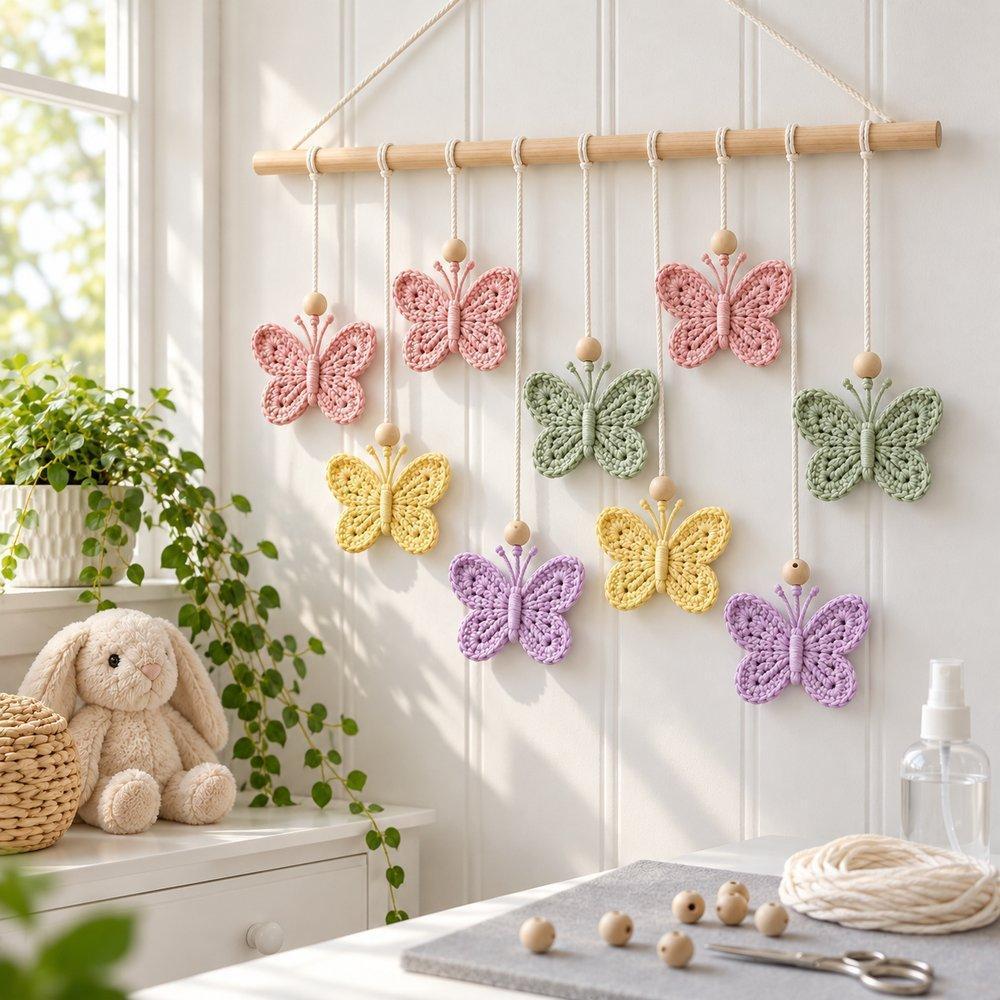
A butterfly hanging combines wings, bodies, a hanger, and strings. Jennifer Renaud’s small wrapped-body butterfly looks quickest to repeat; for the most dramatic wall display, choose Tasha Margette’s mosaic panel. This crochet butterfly hanging pattern guide links free designer instructions for each part, followed by our assembly guide for spacing, staggered strings, and balance.
The linked written patterns were free when checked; optional paid PDFs are separate. Measurements describe the designers’ projects, and n/s means not stated.
- The parts of a butterfly hanging
- Wing patterns that change the silhouette
- Bodies and antennae that finish the shape
- Ready-made hanging designs and their supports
- Full patterns from garland to window ornament
- Our assembly guide for a balanced hanging
- Yarns and wingspans at a glance
- Hanging your butterflies safely
The parts of a butterfly hanging
The hanger holds the strings, and the strings hold the butterflies. Choose a motif that suits your available yarn before deciding how many strands your wall space can comfortably hold.
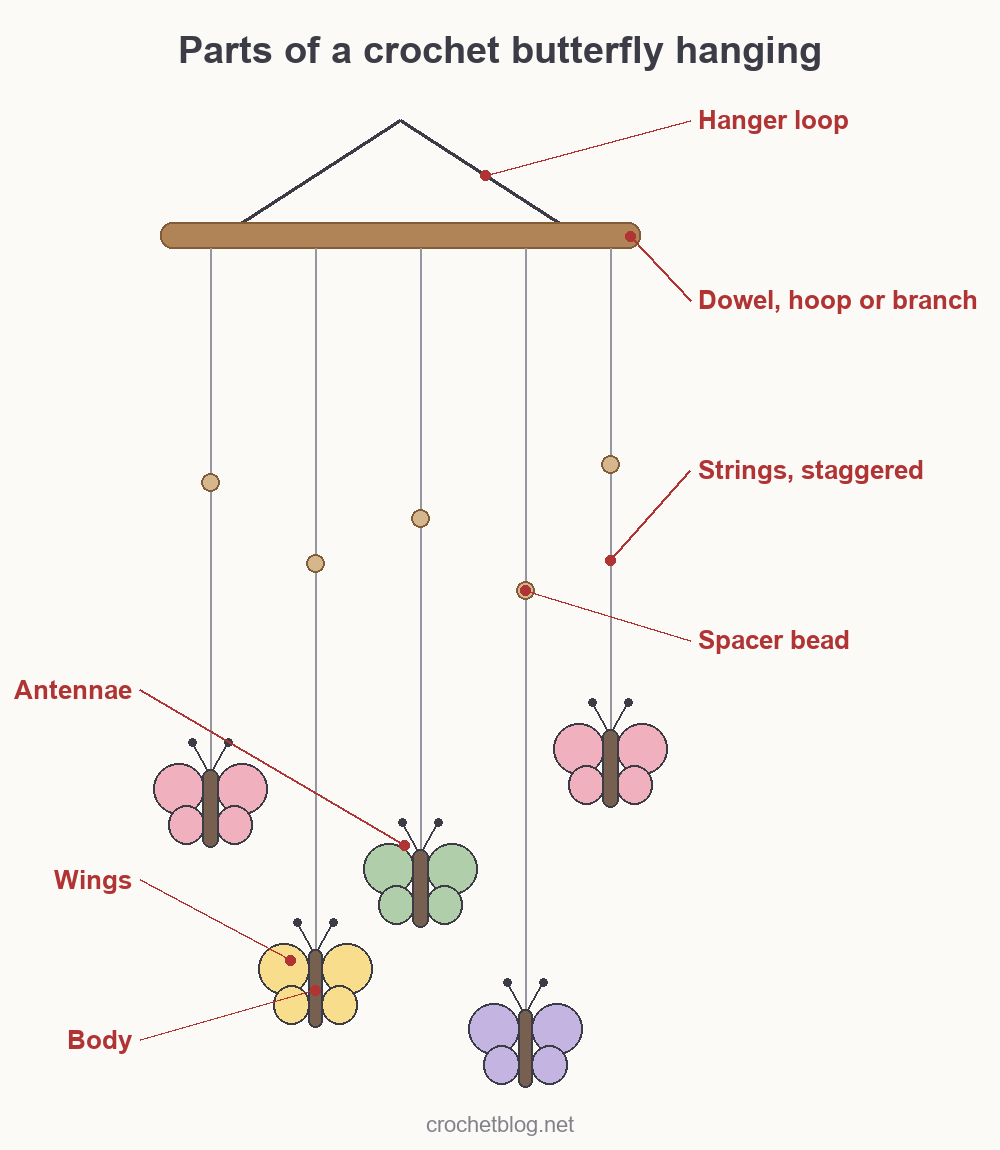
- Hanger: A dowel gives a straight top edge, while a hoop distributes butterflies around a circle.
- Strings: Strong cord or thread carries the butterflies and sets their hanging heights.
- Butterflies: Finished wings, bodies, and antennae supply the color, shape, and texture.
- Beads: Optional beads add visual punctuation between motifs on adult display pieces.
Wing patterns that change the silhouette
Choose the wing technique first: filet creates open mesh, a granny motif creates a framed focal point, puffs add rounded texture, and picots sharpen the outline. For more ways to read butterfly shapes, see Crochet Butterfly Diagrams and Inspiration.
Lace Filet Butterfly on Open Mesh
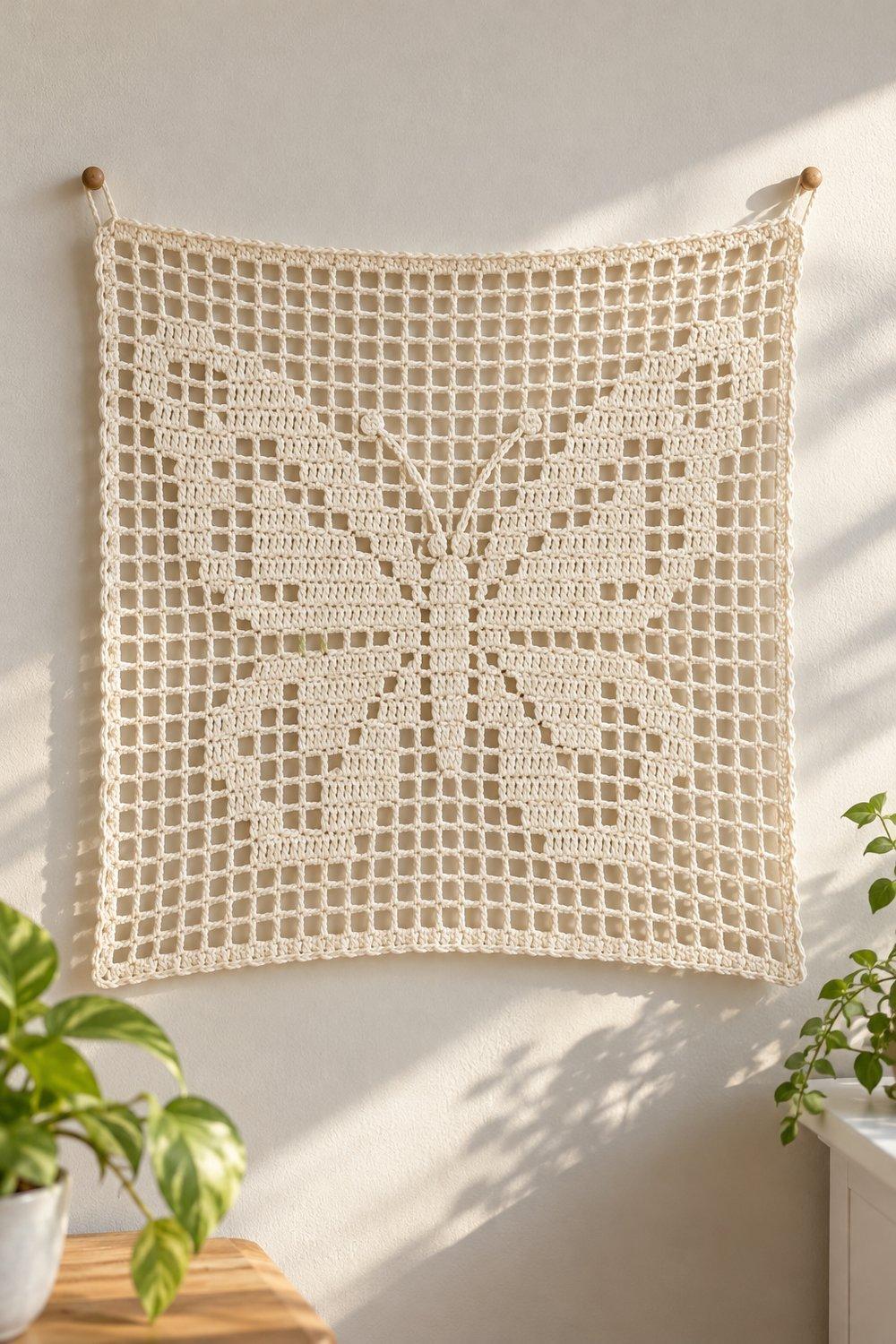
A butterfly silhouette floats inside a square of open mesh, giving you a graphic lace panel rather than a loose wing motif. Pia Thadani uses double crochet blocks and chains, with both lacy and solid butterfly options. The designer rates it basic. Choose this for a broad centerpiece above smaller dangling butterflies, or hang the square by itself. Keep the mesh around the butterfly intact: it is part of the design and provides its support.
Yarn and hook: Worsted or fingering weight; 5 mm (H-8) or 2.75 mm (C-2), respectively. Butterfly wingspan: n/s; finished blocked squares are 25 in (64 cm) or 14 in (36 cm), respectively.
Free pattern: Pia Thadani, Stitches n Scraps (a paid PDF also exists; the blog version is free).
Granny Motif Butterfly with Raised Wings
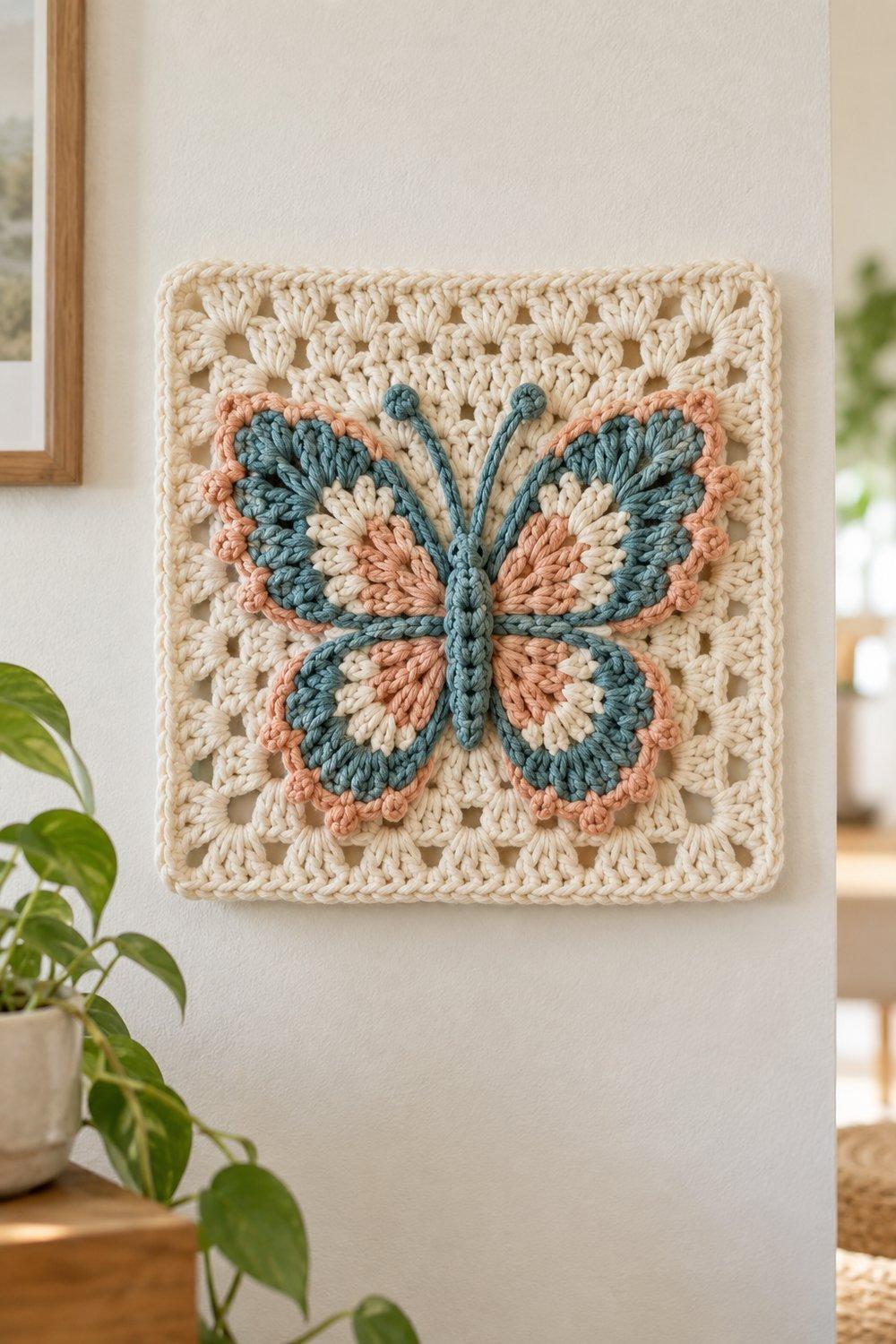
This butterfly sits above a cream granny square, so its raised wings cast a small shadow against the background. Roseanna builds the butterfly first and adds the square through the remaining back loops. Double crochet clusters, trebles, picots, and surface chains give the motif definition. The page also permits using the butterfly alone. The level is n/s; as an editorial guide, this suits a confident beginner comfortable identifying front and back loops.
Yarn and hook: Circulo Amigurumi yarn; weight n/s on this page. Hook: 3 mm (D, as labeled by the designer). Butterfly wingspan: n/s; the complete square measures about 3 in (8 cm) across.
Free pattern: Roseanna, Moara Crochet
Puff Stitch Butterfly with Plump Wings
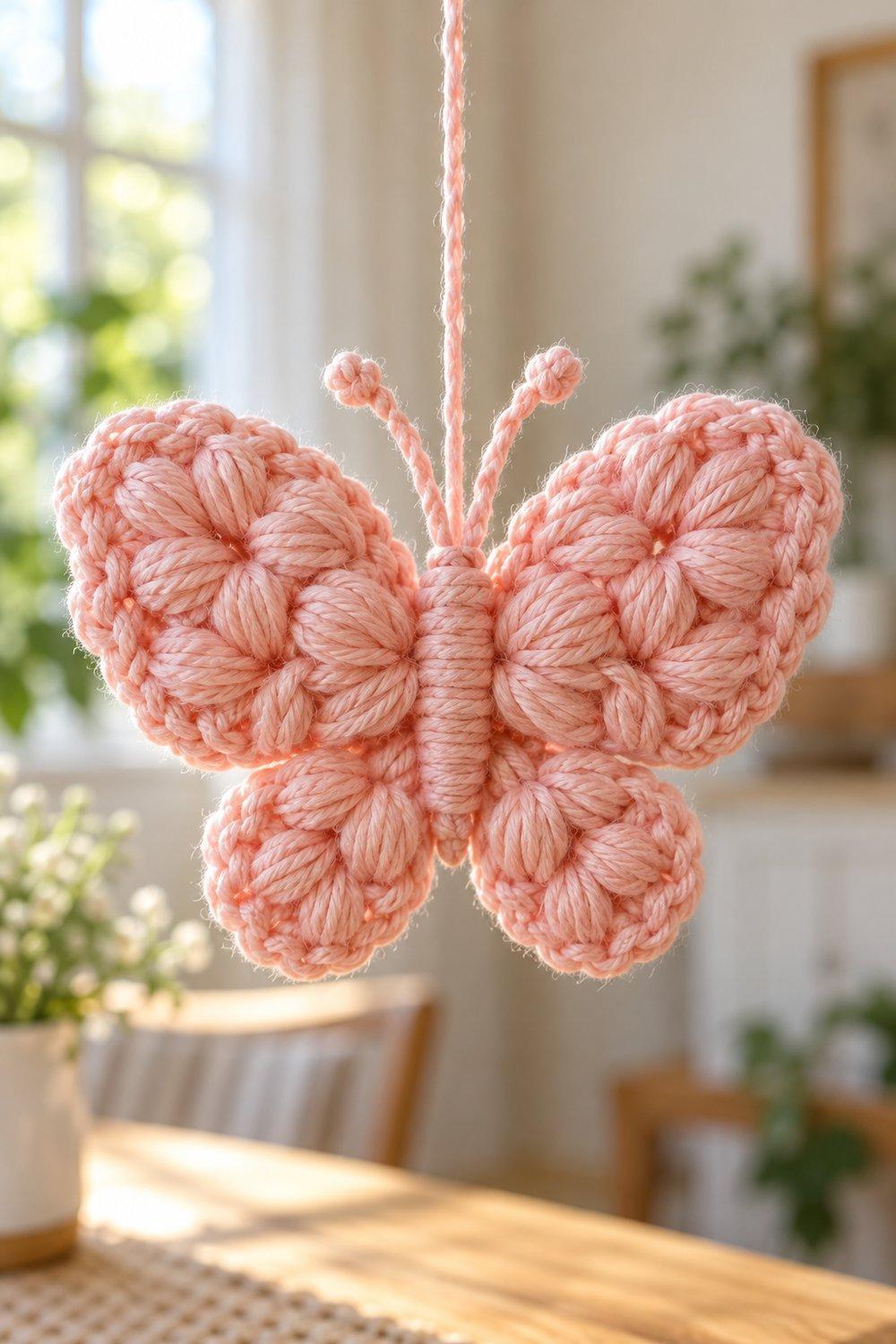
Plump puff stitches give this tiny butterfly a rounded, almost petal-like outline. Amy Lehman combines puff stitches with chains and slip stitches, then draws the yarn ends upward for antennae. This free crochet butterfly pattern lists fine yarn, although the surrounding introduction also discusses heavier alternatives. Use the fine-yarn version as your smallest accent between larger butterflies. The designer describes it as beginner-friendly, making it a useful choice when you want an approachable motif to repeat.
Yarn and hook: Fine yarn in the written materials; 3.75 mm (F-5). Wingspan: 1 in (2.5 cm).
Free pattern: Amy Lehman, Amy’s DIY Frugal Life
Rufflewing Butterfly with Picot Edges
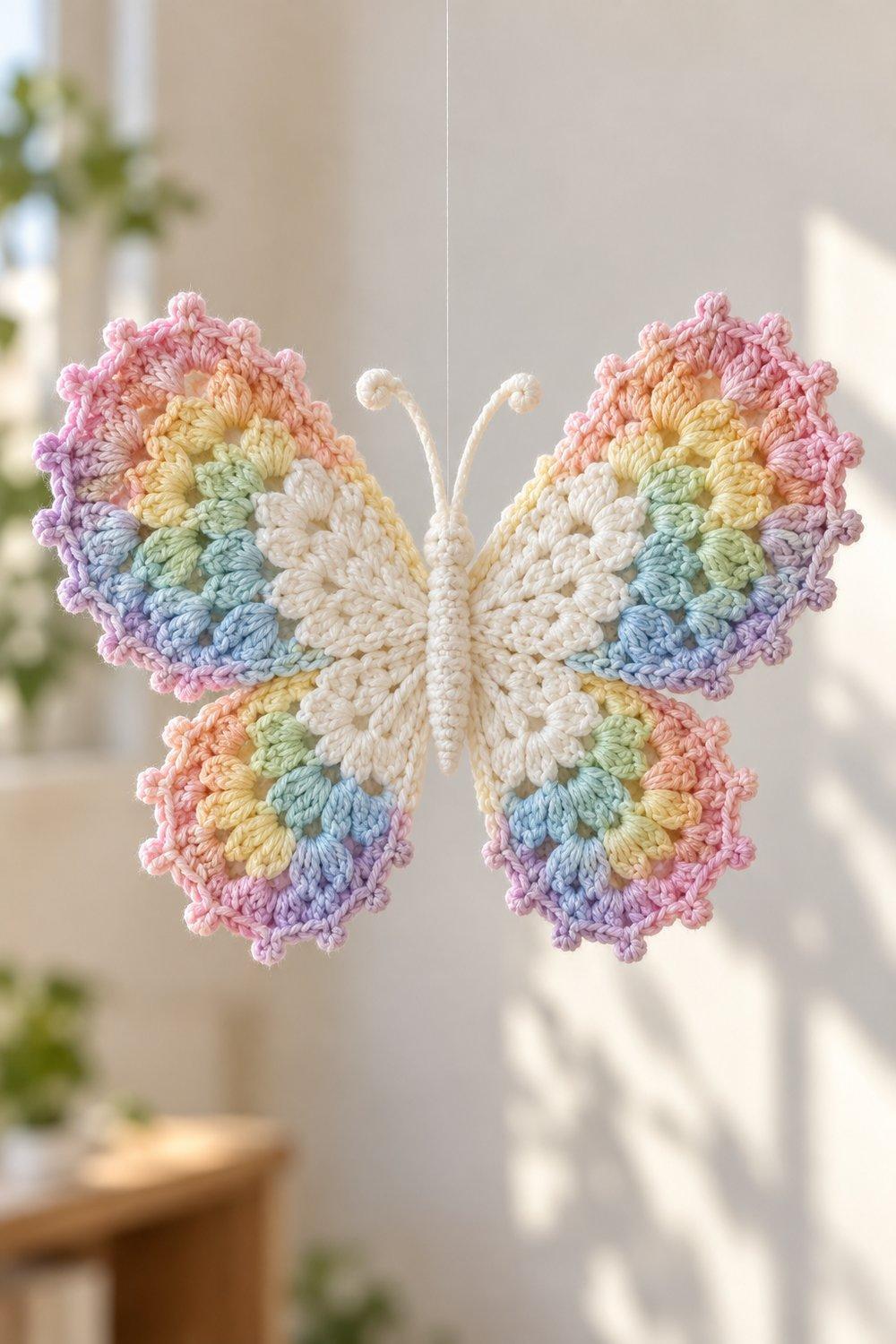
A white center and pastel rainbow edging make this butterfly a gentle match for pale wood and cream cord. Krisztina Anna Edomer uses double crochet clusters and picots to create the shaped outline. The advanced-beginner rating is helpful if you already know basic stitches and want a little more detail. Let the edging stay visible by giving this butterfly its own space on a strand, rather than covering the wing tips with beads or neighboring motifs.
Yarn and hook: Hobbii Friends Cotton 8/4 and Friends Cotton 8/4 Print; US weight n/s on the pattern page. Hook: 3 mm (US letter n/s). Wingspan: 3 in (8 cm), as rounded by the designer.
Free pattern: Krisztina Anna Edomer, K.A.M.E. Crochet
Bodies and antennae that finish the shape
A narrow stitched body reads as a strong center line; a wrapped body gathers soft wings into a fuller silhouette. Keep each designer’s body with its own wings when you want the stated result. For a different decorative finish, browse Crochet Butterfly Ornaments with Wooden Heads as visual inspiration.
Chain and Slip Stitch Butterfly Body
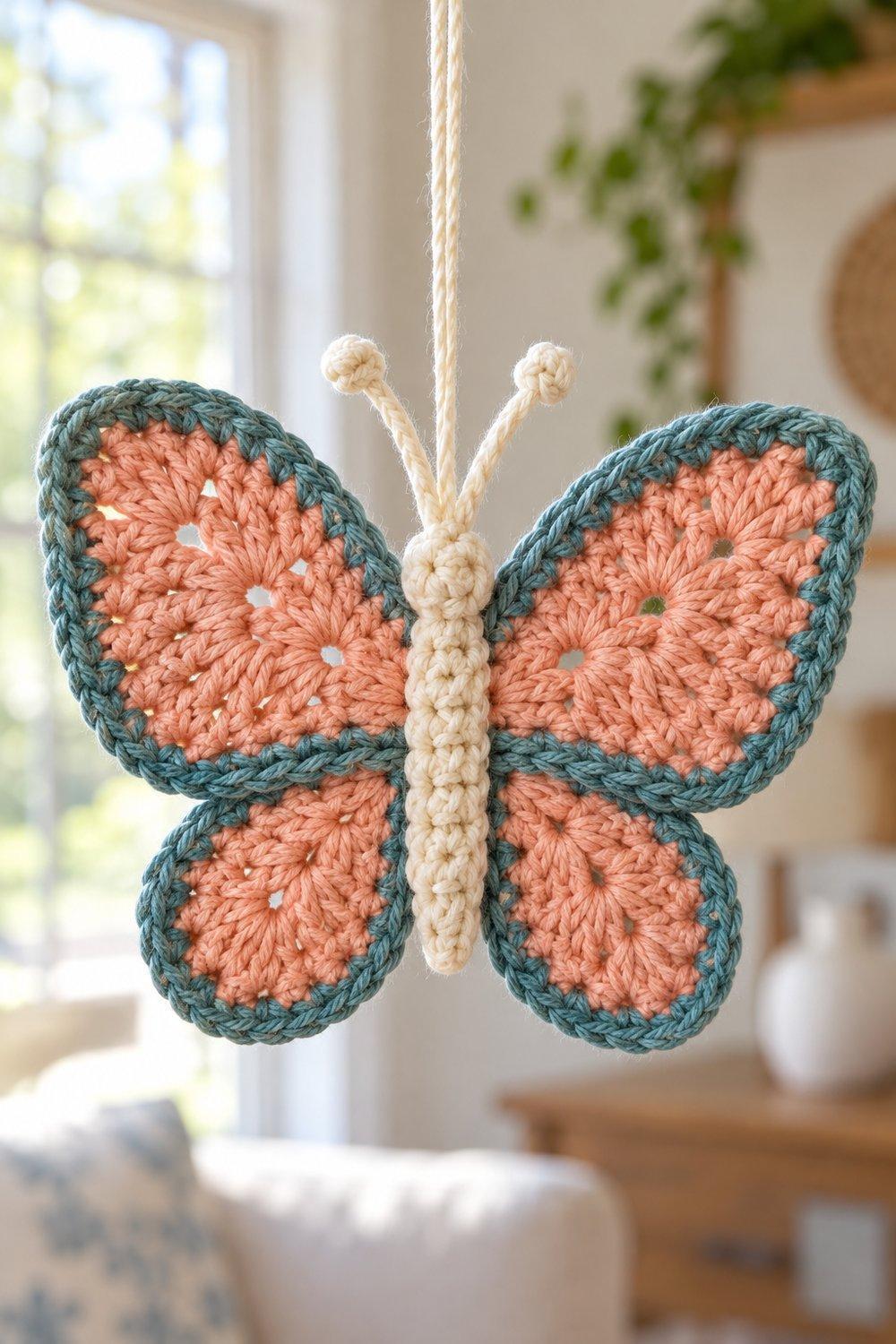
Choose this applique when you want the body to remain a clear line through the wings. Oui Crochet begins with a foundation chain and works along it, using slip stitches and single crochet before adding the wings. Taller stitches and a contrasting outline shape the wings, while knotted yarn ends provide antennae. The level is n/s; the range of stitch heights makes it a reasonable confident-beginner option. It adds structure without a separate bead body.
Yarn and hook: Worsted weight cotton; 6 mm (J-10), a conventional equivalent for the source’s J hook. Wingspan: n/s.
Free pattern: Oui Crochet, Oui Crochet
Small Butterfly with a Wrapped Yarn Body
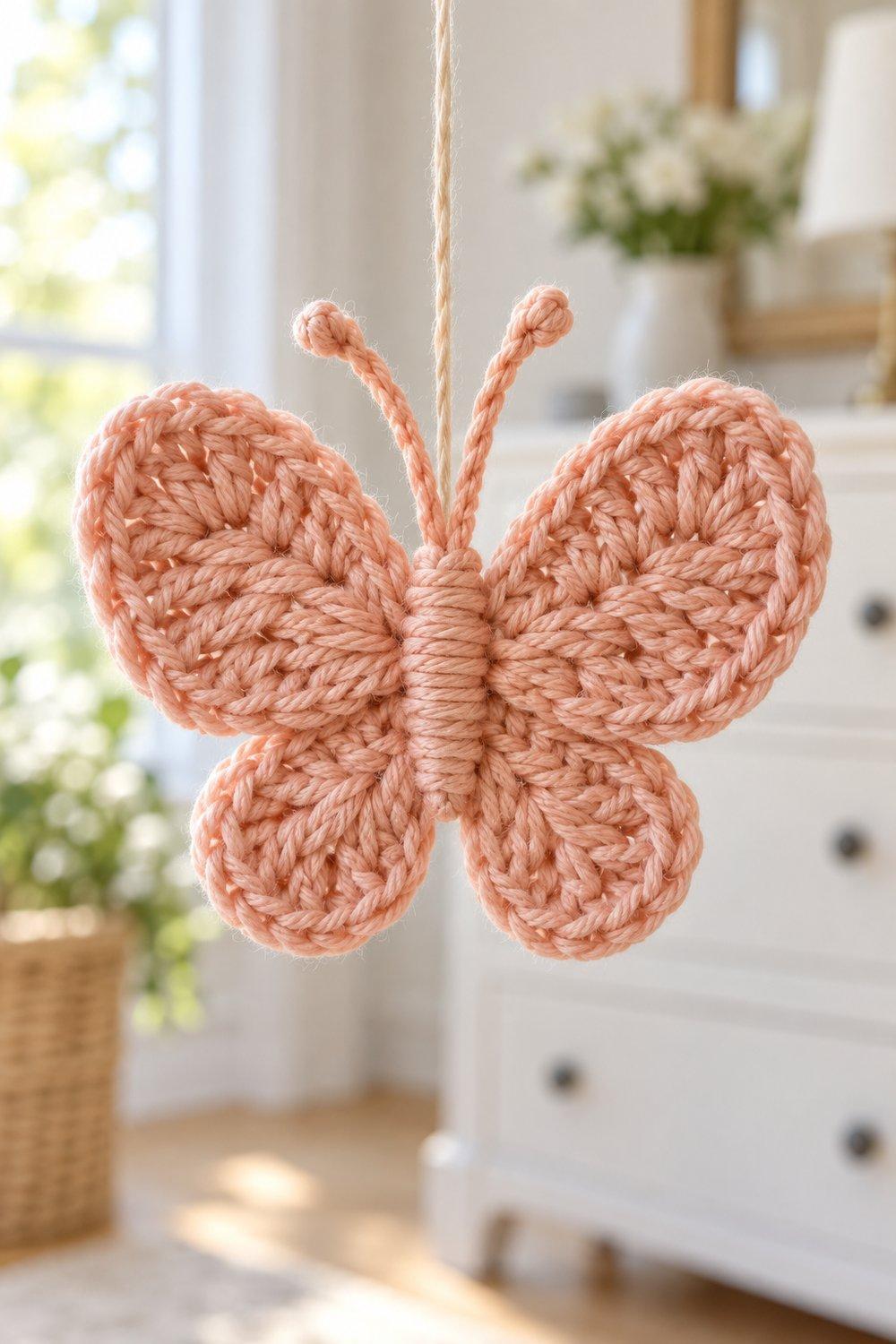
A wrapped yarn center gathers the small butterfly into a recognizable shape and leaves short ends for antennae. Jennifer Renaud’s smaller option uses treble crochet wings around a magic ring, with the body added afterward. It looks quickest to repeat, an editorial judgment based on construction. The level is n/s; choose it if you can handle a magic ring and treble crochet. The same page also offers a larger, more detailed butterfly.
Yarn and hook: Lily Sugar n’ Cream worsted weight cotton; 4 mm (G-6). Small butterfly wingspan: 1.75 in (4.5 cm).
Free pattern: Jennifer Renaud, A Crocheted Simplicity
Ready-made hanging designs and their supports
These complete designs show how the support changes the result. A flower-covered hoop makes a cloud of butterflies, a dowel supports a graphic panel, and a loop carries a narrow spiral. An embroidery hoop or macrame ring can support your own arrangement below; changing a designer’s support is an adaptation.
Butterfly and Flower Hoop Mobile
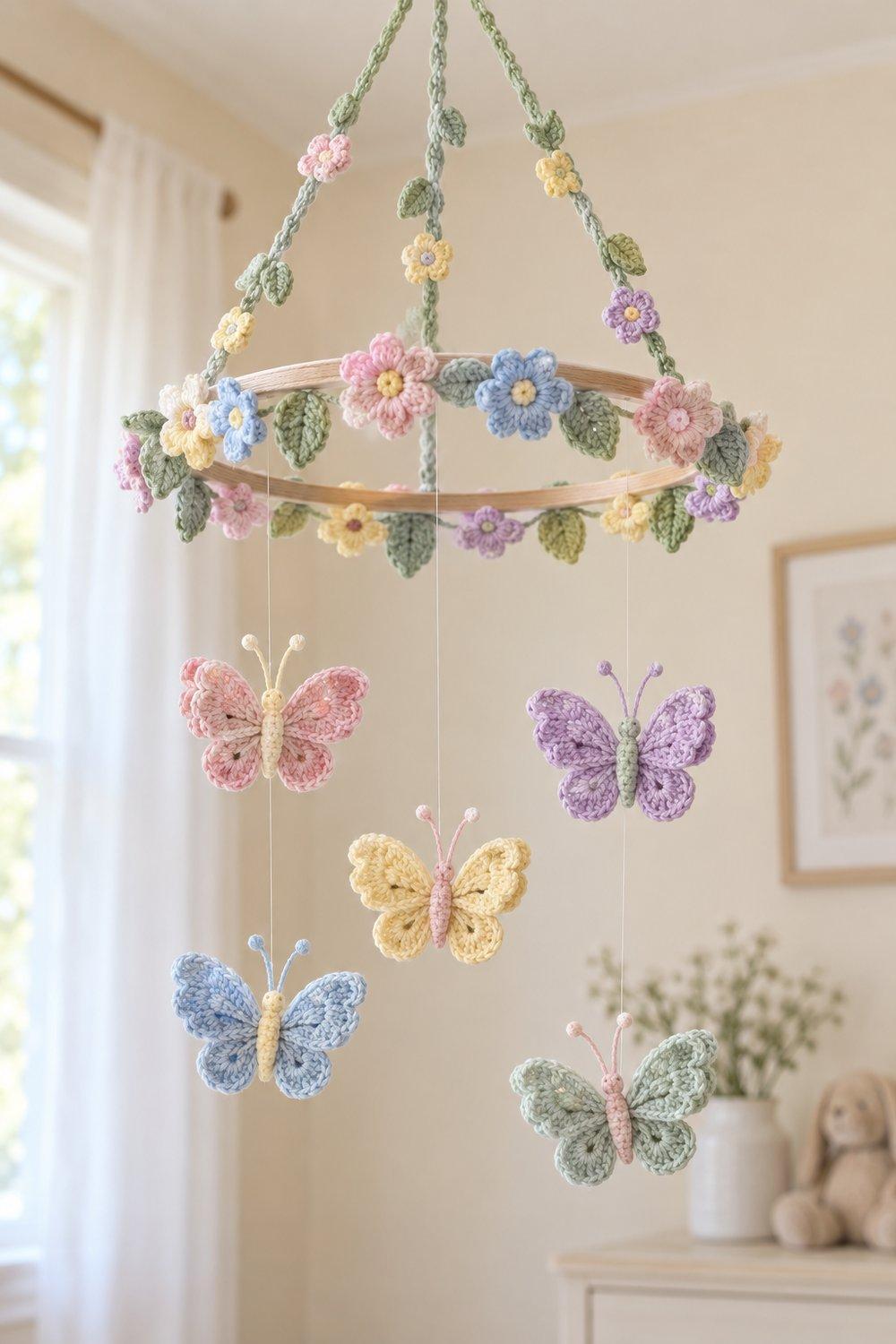
Pastel flowers and leaves cover the hoop while folded butterflies float beneath it on nearly invisible thread. Penny provides a downloadable written pattern for the butterflies, floral trim, and assembly. The stitches are given in British terminology, so US readers should use the included terminology explanation carefully. The level is n/s; the motifs are approachable, while the floral arrangement adds finishing work. Choose this complete design when the top of your mobile should be as decorative as the butterflies.
Yarn and hook: Planet Penny mercerized cotton; weight n/s. Hook: n/s in mm and US letter. Butterfly wingspan: n/s; wooden hoop diameter: 7 in (18 cm).
Free pattern: Penny, Planet Penny
Mosaic Butterfly Panel on a Dowel
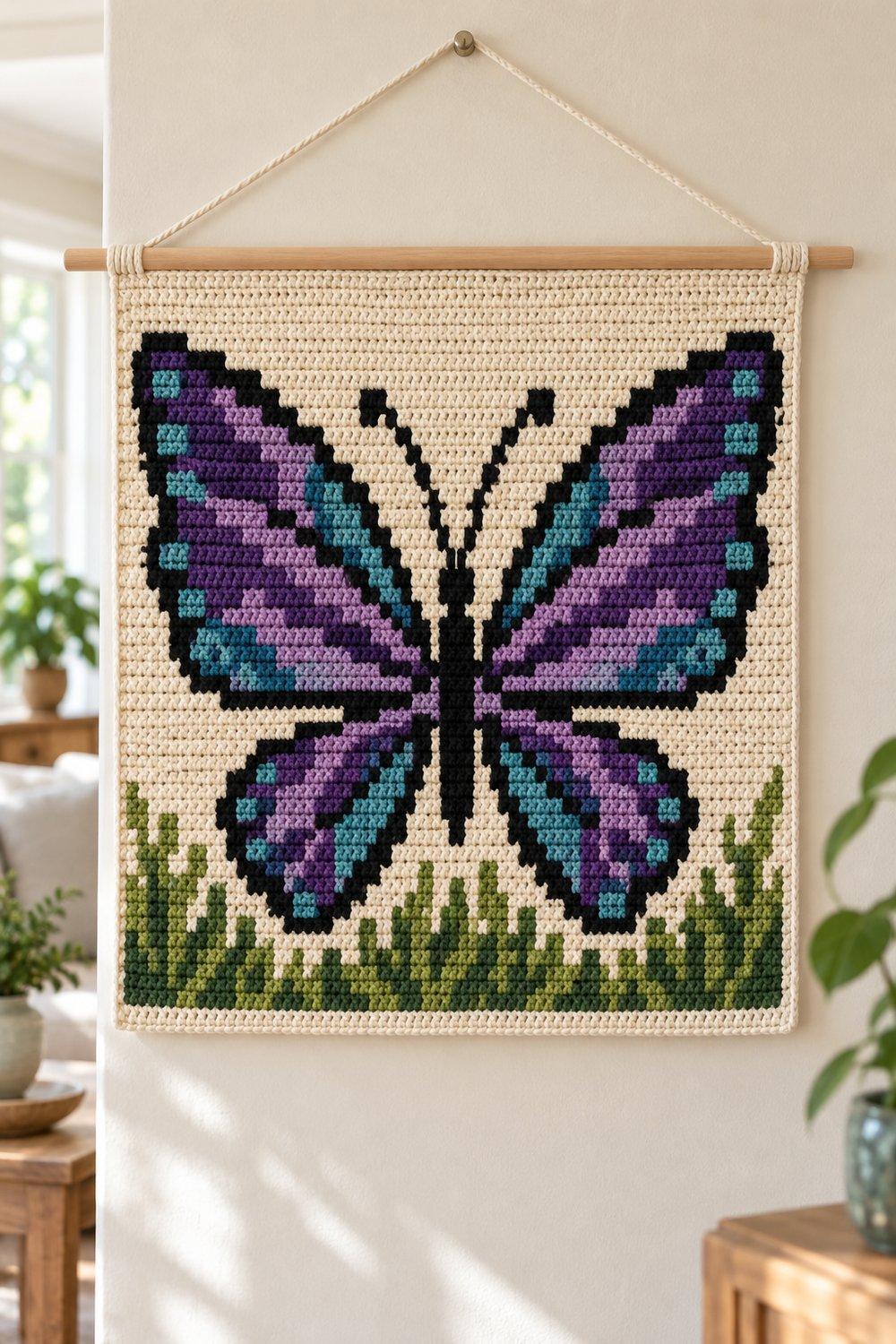
A butterfly rises above green grass in a rectangular panel, with purple, teal, black, and pale background colors giving the image strong contrast. Tasha Margette uses overlay mosaic crochet, including back-loop single crochet and front-loop double crochet. This is the most dramatic wall display here as an editorial visual choice. The designer rates it intermediate. Its dowel attachment and border finishing are included, making it a complete crochet butterfly wall hanging rather than a collection of separate motifs.
Yarn and hook: Light or medium weight yarn; 4–5.5 mm (G-6 to I-9), selected for the yarn. Butterfly wingspan: n/s; finished panel dimensions: n/s.
Free pattern: Tasha Margette, Stardust Gold Crochet
Spiral Drop with a Granny Butterfly
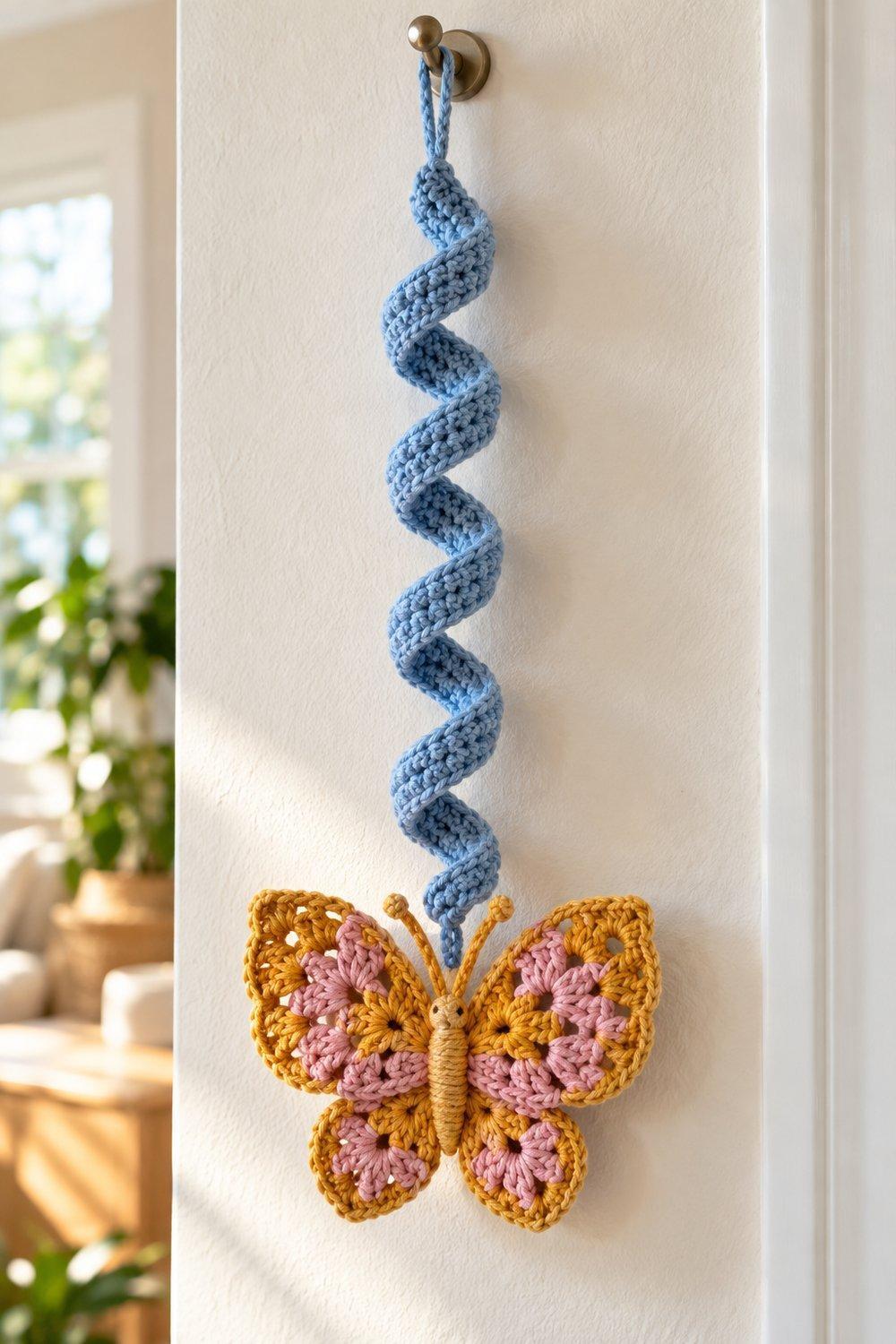
A soft blue spiral ends in a mustard-and-blush granny-style butterfly, giving you a narrow hanging with plenty of movement. Sandra Regev combines half double crochet in the spiral with grouped double crochet in the butterfly and a wrapped chain body. The page lists it as beginner, though its tips call it intermediate. The pattern includes a hanging loop; you can display that loop from a hook or, as your own styling choice, a smooth branch.
Yarn and hook: Medium weight cotton; 4 mm (G-6). Butterfly wingspan: n/s; complete hanging height: 18 in (46 cm).
Free pattern: Sandra Regev, Sandra Stitches
Full patterns from garland to window ornament
Choose a start-to-finish project when you prefer a planned composition. The garland travels horizontally, the nursery mobile hangs around a ring, and the window ornament keeps the focus on a single butterfly. Their linked pages include finishing or direct links to the component instructions.
Rainbow Butterfly Garland on Cotton Yarn
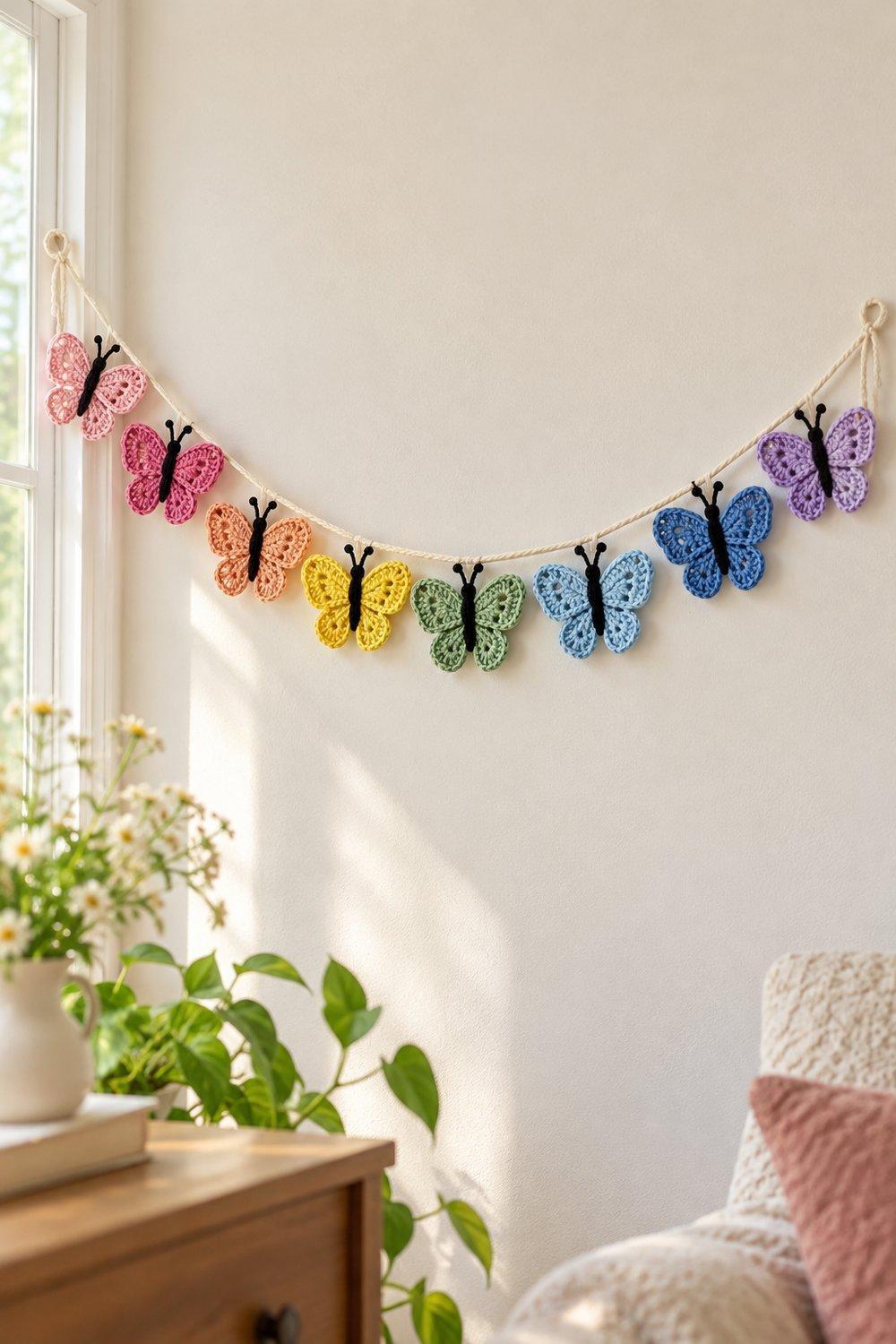
Black bodies give these colorful butterflies a crisp center, while the wings spread in recognizable upper and lower lobes. Maggie Trunkhill uses single crochet for the body and taller stitches, including double and treble crochet, to shape the wings. Her assembly directions thread the finished butterflies onto yarn so their positions can be adjusted. The level is n/s; shaping and turning make it a confident-beginner option. Choose this crochet butterfly garland for a horizontal display across a wall or shelf.
Yarn and hook: Sport or DK yarn; sample uses MillaMia Naturally Soft Cotton. Hook: 3 mm (US letter n/s). Wingspan: n/s.
Free pattern: Maggie Trunkhill, Daisy Girl Crochet
Hangry Caterpillar Nursery Ring Mobile
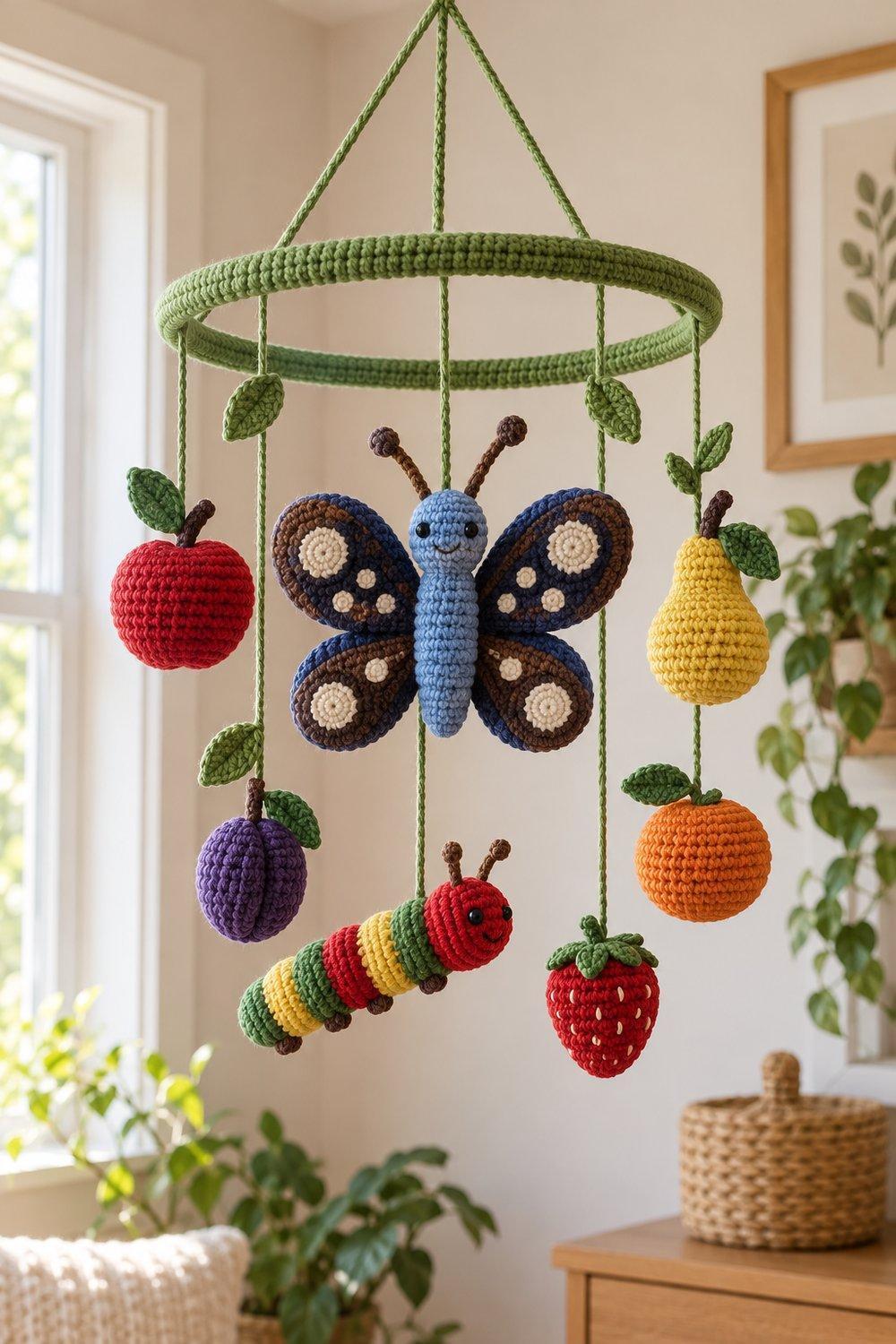
This complete nursery mobile combines a stuffed butterfly, caterpillar, and fruit beneath a covered ring. Ruth Haydock links the component patterns and supplies the assembly sequence. The intermediate project uses crochet in the round, shaping, and sewn details. The free blog instructions use UK terms; paid US PDFs are separate. Choose this when you want a little story in your crochet butterfly mobile, and you also need the linked butterfly page for the whole design. Keep stuffed pieces and a crib mobile out of a baby’s reach, and take them down once the baby can push up on hands and knees.
Yarn and hook: Stylecraft Special DK acrylic; 3 mm (C/2 or D/3, as stated by the designer). Butterfly wingspan: 7 in (18 cm), using the source’s rounded pair.
Free pattern: Ruth Haydock, Ruth Haydock
Butterfly component: Ruth Haydock’s butterfly and caterpillar instructions.
Colorful Butterfly Window Hanging
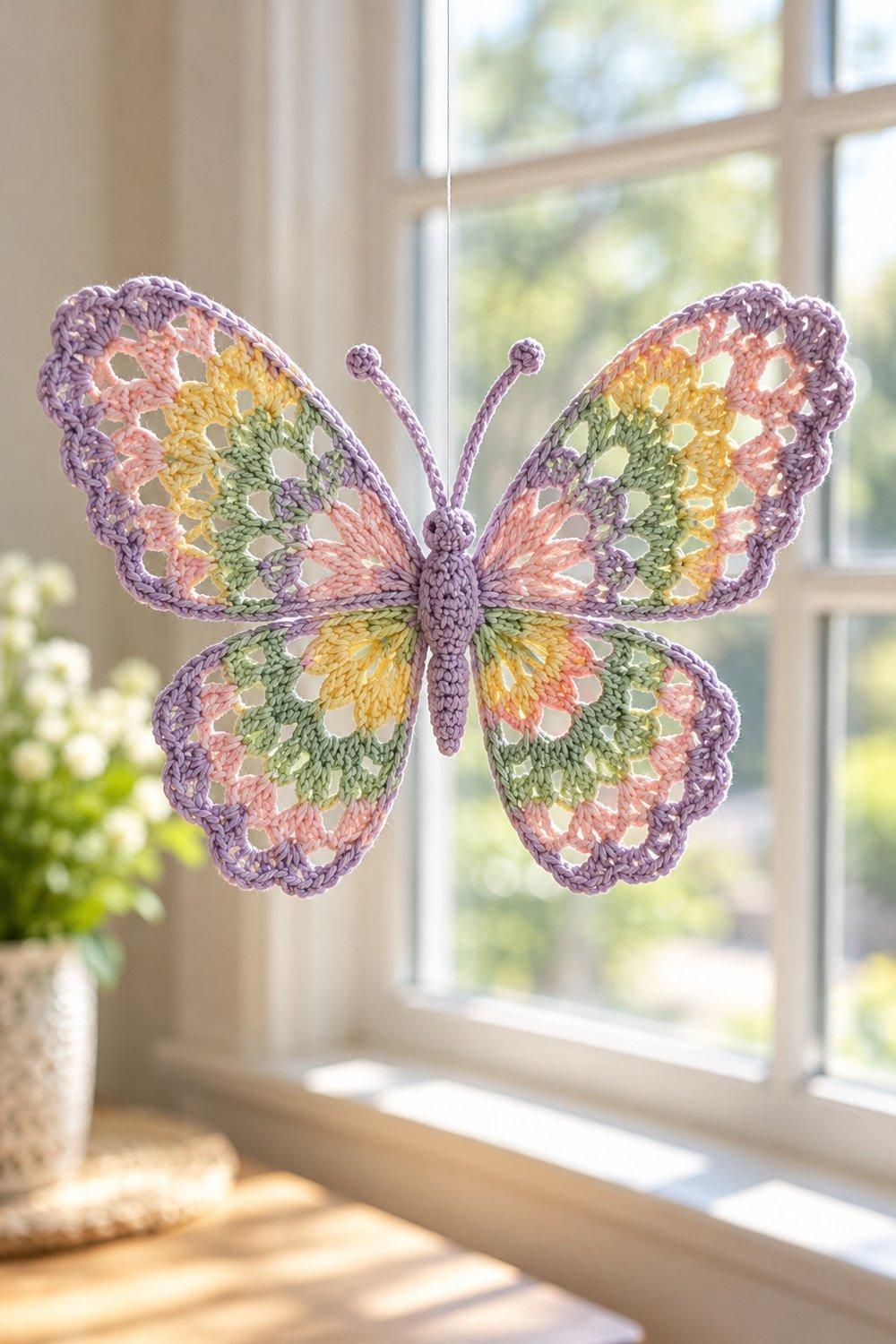
Donna Browne’s butterfly is designed for display on walls or in windows. Separate upper and lower wings join into a flat silhouette with openwork centers and shaped edges. The free page includes assembly photos and uses US terms. The skill level is n/s; joining the wings calls for careful finishing. Window suspension is an editorial display choice; the pattern completes the butterfly without a hanging cord.
Yarn and hook: DK or aran/worsted yarn; 3 mm (US letter n/s). Butterfly wingspan: n/s; the whole piece measures about 9 x 10 in, with orientation unspecified by the designer.
Free pattern: Donna Browne, Baby Crochet Designs
Our assembly guide for a balanced hanging
Use this arrangement for separate finished butterflies. These are our suggested layout ranges, not tested crochet dimensions or a stitch pattern. A narrow motif needs less space than a broad wing, so lay out your actual butterflies before cutting. Choose either a dowel for the wall or a hoop for an open mobile.
- A smooth wooden dowel about 12–18 in (30–46 cm) long, or a hoop about 6–10 in (15–25 cm) across.
- Strong cotton cord for suspension, finer cotton string for motifs, scissors, a tapestry needle, and removable markers.
- Optional smooth wooden beads for an adult display; choose holes that let your string pass easily.
- A blocking surface, rustproof pins, and a fabric stiffener suitable for your yarn, used according to its label.
- Your completed butterflies, plus a secure wall or ceiling fixing suitable for the support and its total weight.
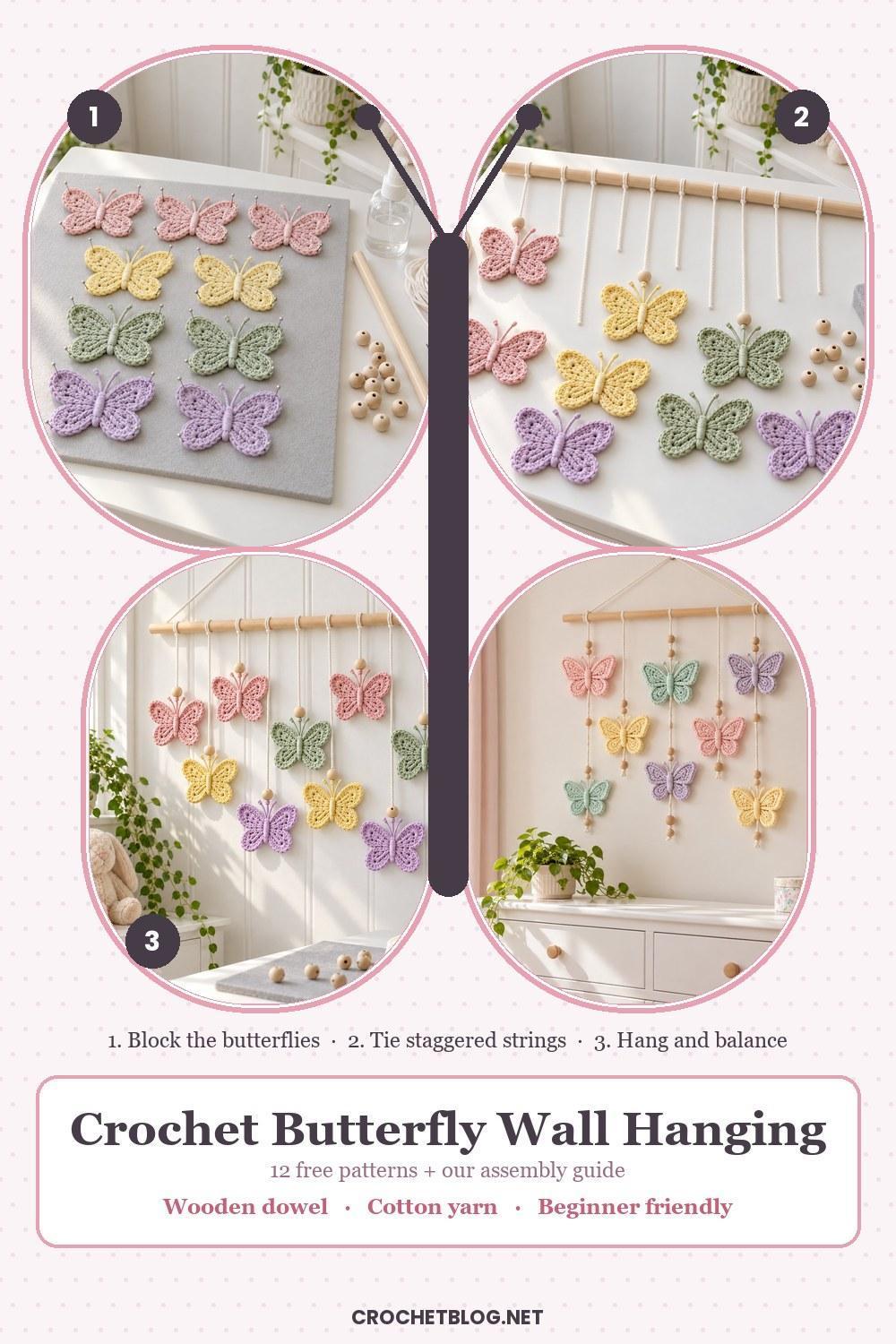
- Block the finished butterflies. Dampen and shape flat motifs according to their yarn care instructions. Pin the wings symmetrically, apply compatible stiffener if needed, and let them dry fully. Support dimensional bodies separately so their shape stays rounded; leave stuffed designs soft unless their designer says otherwise.
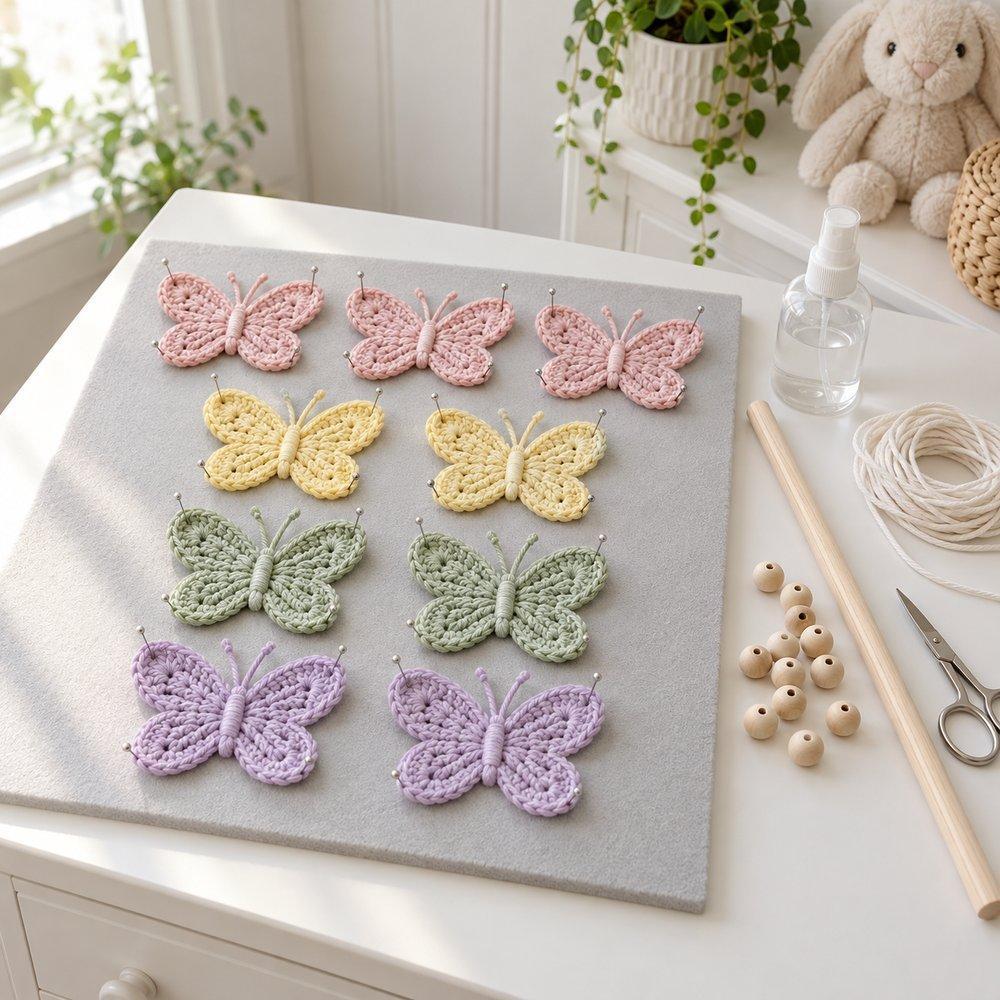
- Mark the hanger. Spread the finished butterflies below it before marking attachment positions. For small motifs, begin with roughly 2–3 in (5–8 cm) between strings, then widen the gap until wing tips clear each other. Center the overall arrangement rather than forcing every motif into a rigid grid.
- Cut staggered strings. Try visible drops of about 8–16 in (20–41 cm), measured from the hanger to the lowest butterfly on each strand. Add about 4–6 in (10–15 cm) of string for knots and adjustments. These are starting ranges for layout; the final drop follows your actual motifs.
- Tie and bead. Secure each butterfly through its firm central body rather than a delicate wing tip. Thread any display beads onto the strand and knot them securely in place. Tie the strings to the marks, leaving the extra length available until the whole arrangement is balanced.
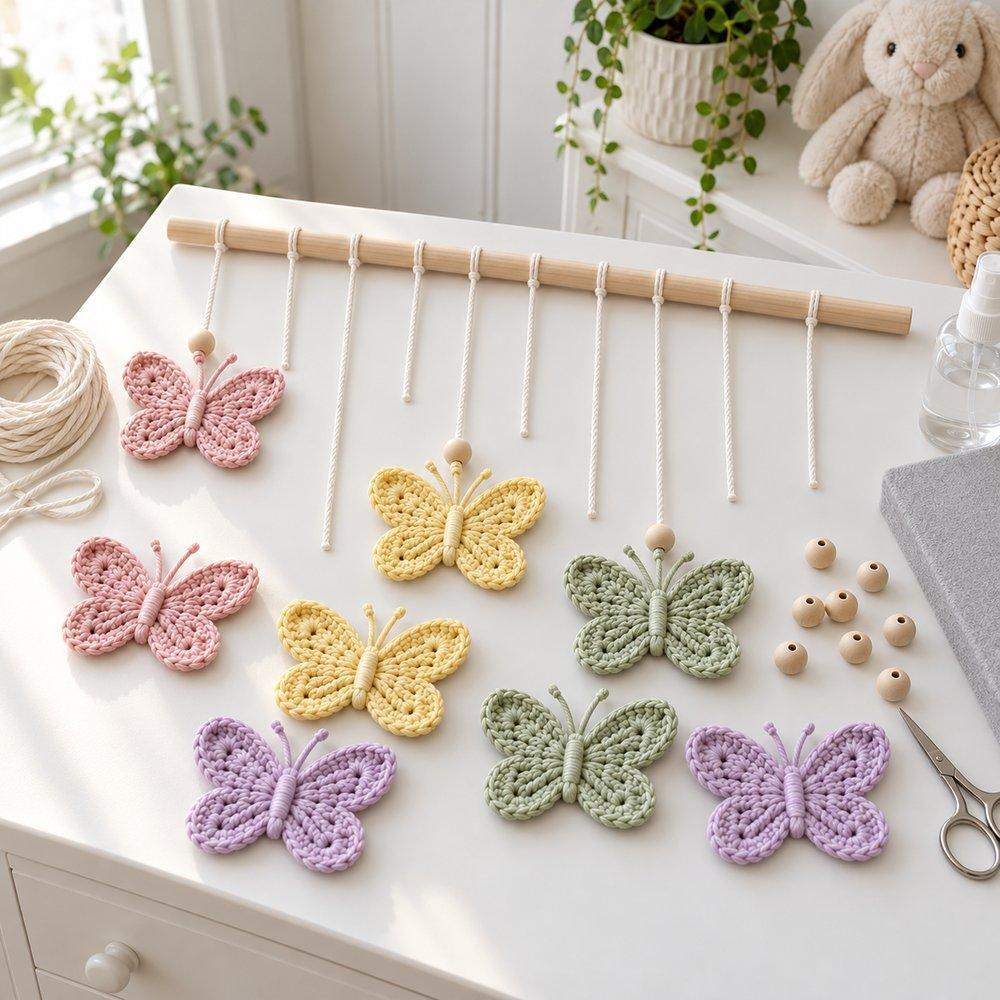
- Balance the support. Suspend the dowel from cord attached near its ends. For a hoop, distribute suspension cords around its rim and gather them above the center. Move heavier motifs inward or redistribute their positions until the support stays level; adjust the knots before trimming the tails.
- Separate the silhouettes. Turn the butterflies toward the viewing side and shift their heights until the wing outlines remain readable. Give nearby strands room to move without snagging antennae. For a wall display, leave enough clearance for raised wings to keep their shape against the background.
- Hang the finished piece. Use a suitable fixed hook or anchored fitting, settle the hanger into position, and gently test each attachment. Trim excess string only after the knots hold and the support hangs level. Place the finished decoration where children and pets cannot reach it.
For a closer look at a small motif, watch Amy Lehman’s puff stitch butterfly tutorial. It accompanies her written pattern above and shows the wing construction and yarn-end antennae. Use the video for the crochet component, then return to this assembly guide to plan your hanger and strings.

Yarns and wingspans at a glance
These are stated butterfly wingspans from the linked patterns, rather than estimates from photographs; n/s marks a missing wingspan. Each size belongs to that designer’s yarn and hook combination. Keep the metric hook measurement as your reference: US letter labels vary, and the table preserves the unusual label supplied by Ruth Haydock.
| Yarn | Hook | Wingspan in the pattern | Best for |
|---|---|---|---|
| Fine yarn, Amy Lehman’s written materials | 3.75 mm (F-5) | 1 in (2.5 cm) | Tiny puff accents |
| Lily Sugar n’ Cream worsted cotton, Jennifer Renaud | 4 mm (G-6) | 1.75 in (4.5 cm), small option | Repeated wrapped-body motifs |
| Friends Cotton 8/4, K.A.M.E. Crochet; US weight n/s | 3 mm (US letter n/s) | 3 in (8 cm), source-rounded pair | Picot edges and pastel color |
| Stylecraft Special DK acrylic, Ruth Haydock | 3 mm (C/2 or D/3, source labels) | 7 in (18 cm), source-rounded pair | Stuffed mobile centerpiece |
| DK or aran/worsted yarn, Donna Browne | 3 mm (US letter n/s) | n/s; whole-piece dimensions given above | Openwork window butterfly |
Match texture as well as color when combining patterns. Keep a larger motif as the focal point and repeat a smaller shape nearby. A consistent body color or natural wooden support can bring those constructions together.
Hanging your butterflies safely
If displayed over a crib, keep the entire mobile and every cord beyond the baby’s reach, securely mounted outside the sleep space. Follow the CPSC guidance on mobiles: remove an overhead crib mobile when your baby begins pushing up, or by about 5 months, whichever comes first. Keep loose beads and detachable small parts away from babies; these handmade hangings are display decorations.
Choose filtered daylight for a window hanging because strong sun can fade colored yarn. Position cords clear of window hardware and blind cords, and move the decoration to an adult display area as children grow. A wall above a dresser can show off the stitches while keeping the hanging separate from the crib.
Next: explore Floral Wall Hanging Crochet for a companion display, or Crocheted Snowflakes Wall Hanging for a seasonal change.
CHECK MORE CROCHET PATTERNS